Most of the healthcare organizations and staffing firms we work with are not running outdated processes because they do not care about efficiency. They are running them because the processes were built for a workforce that no longer looks the way it did.
When the long-tenured hospital employee was the norm, a single background check at hire made sense. The clinician stayed put. The report sat in a file. Nobody needed to think about it again for years. Travel nurses now move between facilities every thirteen weeks. Per diem clinicians carry active relationships with multiple staffing firms at once. Contract staff ... Read More

Press Releases and News

08
Jun2026

26
May2026
Most hiring workflows have gone digital: applicant tracking, e-signatures, automated background checks, digital I-9s: organizations have invested heavily in streamlining the process from offer to day one. Yet for many HR, talent acquisition, and compliance teams, one piece of the puzzle has never caught up: fingerprinting.
In the majority of organizations, fingerprinting still runs on paper forms, Excel spreadsheets, and manual follow-up. The result is a process that creates friction at exactly the wrong moment, right before a new hire crosses the finish line.
Here is a closer look at why fingerprint-based background checks remain so difficult for organizations to manage, and ... Read More

15
May2026
Finding the right candidate is only half the work. Getting them from offer acceptance to day one without losing momentum is where many hiring processes quietly break down. Disconnected tools, manual handoffs, and limited visibility into screening progress can slow everything down at exactly the wrong moment.
To address that, Universal Background Screening (UBS) and Greenhouse have formalized their partnership, creating a more integrated path between recruiting decisions and background screening execution. For hiring teams already working inside Greenhouse Recruiting, this means less switching between systems and more visibility where it counts.
How the Integration Works
When a candidate accepts an offer in ... Read More

11
May2026
Most conversations in background screening focus on the same short list: faster turnaround times, new AI features, cleaner candidate experiences, better platform integrations. Those things matter, but there's a quieter factor that often determines whether real innovation actually happens, and whether it holds up five years from now.
Who owns your background screening provider, and how long are they planning to stay?
Behind every product roadmap, every technology investment, and every decision about where to build deep expertise, there's an ownership model shaping what's actually possible.
Why ownership structure matters more than most clients realize
Traditional private equity typically follows a familiar script: acquire ... Read More

04
May2026
A "good enough" background check might actually be good enough for a lot of industries: healthcare is not one of them.
Place a clinician at the bedside, send a caregiver into a patient's home, or staff a critical hospital department, and background screening stops being a procurement line item. It becomes a core part of your risk posture, your brand, and your ability to keep operating.
Many healthcare providers and staffing firms still rely on generalist screening vendors; companies that serve every industry and treat healthcare as just another vertical. At Universal Background Screening (UBS), roughly 70% of our customers are in ... Read More

27
Apr2026
AI is everywhere in 2026. Every vendor pitch deck seems to promise "AI-powered" everything; faster decisions, lower costs, fewer errors. Background screening is no exception.
But if you're responsible for hiring in healthcare or healthcare staffing, you can't afford to adopt AI just because it's trendy. You need an approach that improves speed and efficiency, protects accuracy and compliance, and respects the genuine complexity of healthcare risk and regulation.
At Universal Background Screening (UBS), we've taken a clear position on this: the future of background screening is human-assisted AI. That means AI doing what it does best, guided and governed by human ... Read More

16
Apr2026
If your hiring volume has dipped and your team has more breathing room than it did a year ago, you are in a better position than you might think. Slower periods tend to surface inefficiencies that rapid growth buried, and nowhere do those inefficiencies hide more quietly than inside a background screening program that has never been fully scrutinized.
Most HR and talent acquisition leaders treat a slowdown as something to endure. The smarter move is to treat it as protected time to do the strategic work that gets deprioritized when every week brings a new wave of requisitions. Evaluating your ... Read More
13
Apr2026
A recap of a joint Universal Background Screening & Verisys webinar
The headlines keep coming.
Another healthcare organization fined for employing an excluded provider. A health plan forced to repay millions for claims tied to a sanctioned clinician. A large system struggling to maintain accreditation after auditors uncover serious compliance gaps in workforce screening.
If you work in healthcare HR, compliance, credentialing, or talent acquisition, you already know the pressure. The scrutiny from regulators, accreditors, and payers has intensified, and the margin for error has narrowed. What makes this harder is the uncomfortable reality underneath: many of these failures trace back to the ... Read More
10
Apr2026
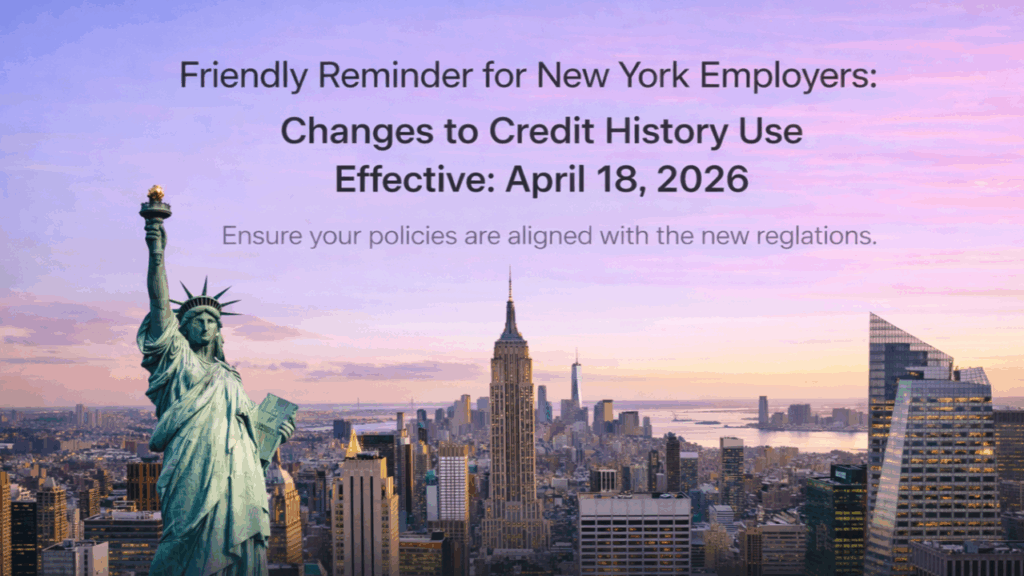
Effective April 18, 2026, a new amendment to New York’s Fair Credit Reporting Act (FCRA) dramatically limits how New York employers can use an applicant’s or employee’s credit history. In general, it will be unlawful for employers to request or use credit reports or any credit-related information in hiring, promotion, compensation, or other employment decisions. This change aligns New York with other states that prohibit credit checks, reflecting research that credit history is a poor predictor of job performance and often contains errors. In plain terms, unless a role meets one of a few narrow exceptions, credit-history screening will be off-limits under New York ... Read More

01
Apr2026
Candidate Fraud and Identity in 2026: Getting It Right Without Breaking the Experience
If you lead a healthcare system or a healthcare staffing firm, you've almost certainly felt it by now: candidate fraud is no longer a fringe issue. It comes up in executive conversations every week.
From misrepresented experience and falsified credentials to identity mismatches and sophisticated synthetic identities, the trust layer of talent has become a strategic concern, not just a compliance checkbox. Organizations are responding by turning to identity verification and enhanced background screening. That makes sense. But there's a catch most vendors won't tell you upfront.
When identity workflows ... Read More
23
Mar2026
When a healthcare professional clears a background check, there is a natural sense of relief. The file looks complete. The criminal history is clean. The license checks out. The hire moves forward.
That moment of clearance can also be exactly where the risk begins.
A case recently highlighted by the Professional Background Screening Association (PBSA) illustrated this in unsettling terms. A healthcare impersonator moved undetected between facilities by exploiting fragmented state reporting systems, cross-state licensing gaps, and delayed federal database updates. No single failure made it possible. It was the accumulated space between systems — the time lags, the jurisdictional seams, the ... Read More

20
Mar2026
How embedded compliance in background screening protects healthcare staffing firms — without slowing down clinical hiring
There's a conversation happening in healthcare staffing organizations across the country, usually between a compliance manager and a recruiter, and it usually goes something like this:
"Did you remember to add the OIG sanctions check for this facility?"
"Which package did you use — this client is a Tier 2 system."
"That order went through without the immunization bundle."
Nobody meant for it to go wrong. But when compliance knowledge lives in spreadsheets, email threads, and the institutional memory of one or two senior people, it's only a matter ... Read More

10
Mar2026
Employers rely on criminal background checks to support safe workplaces, protect their organizations, and make informed hiring decisions. Many people assume criminal searches come from a single source. In reality, background screening uses several types of searches that work together to create a more complete view of criminal history information.
Two of the most important search types are database searches and court searches. Each serves a specific purpose within the screening process. Understanding how these searches work can help employers design a more effective and reliable screening program.
What Are Criminal Database Searches?
A criminal database search scans large collections of public records ... Read More

05
Mar2026
For years, background screening has centered on a single deliverable: the report. A candidate gets ordered, checks get run, data gets gathered, and out comes a bundled document covering everything from criminal records to occupational health results. In plenty of industries, that works fine. In healthcare staffing, it increasingly does not.
When you are placing clinicians across multiple assignments, managing facility-specific compliance requirements, and watching margins closely, the old report-centric model starts showing its limitations. It makes credential reuse harder than it should be, drives unnecessary re-ordering, and slows down the redeployment of clinicians who are already compliant. A credential-centric approach ... Read More

04
Mar2026
Every clinical hire your organization makes carries a question that verification is supposed to answer: did this person actually do what they say they did, in the role they claim to have held? Get that wrong, and the consequences reach well beyond a bad hire.
Large hospital systems process thousands of employment verifications each year. Each one confirms that a candidate truly held the position, credentials, and responsibilities they claim. When clinical staff are involved, the accuracy of that confirmation carries real consequences for patient outcomes.
At the same time, procurement teams are navigating a different reality. Verification costs have risen significantly, ... Read More

02
Mar2026
The Exposure Is Different Here
Every industry has reasons to screen candidates carefully. Healthcare has more of them, and the consequences of getting it wrong are more severe. Hospitals, long-term care facilities, home health agencies, and behavioral health providers employ people who have direct, often unsupervised access to patients who cannot protect themselves. The elderly. The disabled. Children. People in acute medical crisis. The nature of that access means a hiring mistake does not carry typical employment risk. It can cause serious, irreversible harm.
Beyond the patient safety dimension, healthcare organizations operate under layers of federal and state regulatory oversight. That oversight ... Read More

25
Feb2026
Ask most HR leaders whether their screening program includes a criminal background check, and the answer is almost always yes. Ask whether it covers a candidate who lived in three states over the past decade, worked remotely before joining, or has a prior record under a slightly different name variation, and the answer gets more complicated.
That gap between what people assume their screening covers and what it actually covers is where most hiring risk quietly accumulates. And it’s exactly the problem a nationwide criminal search is designed to address.
The Assumption Most Screening Programs Are Built On
Traditional background screening packages are ... Read More

24
Feb2026
Margins in healthcare staffing have always been tight. The past few years have made them tighter. Post-pandemic contraction in key segments, health systems building out internal staffing capabilities, and clients consolidating vendor relationships have all added pressure to a business that doesn't have a lot of slack to absorb it.
In that kind of environment, firms scrutinize the obvious cost centers. What's less obvious is that background screening, typically filed away as a compliance function, is often one of the more consequential levers in the operating model. The firms managing it deliberately tend to look different from the ones running it ... Read More

23
Feb2026
The Assumption Built Into Most Screening Programs
For a long time, background screening programs have been built around a fairly reasonable-sounding idea: if you have a candidate's Social Security number, you have what you need to find their history. One identifier. One search. One hiring decision. The logic holds up until you look at how public records actually work.
Criminal courts, sanctions databases, and exclusion lists do not index records by Social Security number. They index by name. Specifically, the name a person used at the time of an arrest, conviction, or sanction, paired with a date of birth. When someone has ... Read More

18
Feb2026
In January 2023, federal authorities announced the results of a sweeping investigation known as Operation Nightingale. More than 7,600 fraudulent nursing diplomas and transcripts had been sold by accredited but corrupt Florida nursing schools.
Individuals used these documents to sit for national nursing board exams, obtain licensure in multiple states, and secure employment as registered nurses and licensed practical or vocational nurses.
Healthcare employers faced an immediate operational and compliance problem with consequences that extended well beyond the initial headlines.
What Happened in Operation Nightingale
Between approximately 2016 and 2021, operators at several Florida-based nursing schools sold fake diplomas and transcripts for about $15,000 ... Read More

17
Feb2026
In healthcare and healthcare staffing, everyone is chasing the same outcome: get qualified clinicians in place quickly, safely, and compliantly. The race to fill open roles has never felt more urgent, and the pressure on margins has never been heavier.
Somewhere inside that race, there's a friction point that rarely makes it onto a dashboard but quietly costs real money. It slows time-to-fill, frustrates clinicians before they ever step on site, and chips away at drop-off rates that most organizations can't fully explain.
That friction point is the background screening experience.
At Universal Background Screening, one of the most consistent things we've heard ... Read More

14
Feb2026
Healthcare workforce compliance used to be something you checked off at hire. Now, it is a daily responsibility. Every practitioner, clinician, and technician in your organization needs an active, valid license to practice–not just on their first day, but every day after. When a lapsed credential slips through, the consequences are immediate: regulatory penalties, accreditation risks, payer clawbacks, and patient safety concerns.
Most healthcare organizations are still running compliance systems that weren't built for this continuous reality.
The Problem with Traditional Verifications
Traditional primary source verifications take time and are often siloed. They usually require 3 to 5 contact attempts over 5 to ... Read More

10
Feb2026
You've probably heard vendors promise "instant background checks." In our last article, we covered why that's not realistic for regulated hiring. This time, let's talk about what actually makes enterprise clients stay with a screening provider year after year.
It's not turnaround time alone.
The Easy Metrics Don't Tell the Whole Story
Turnaround time, cost per report, volume capacity: these are easy to measure and easy to compare on a spreadsheet. They matter when you're hiring at scale.
What keeps enterprise teams satisfied over the long term is reliability.
Consistency Across Thousands of Searches
Enterprise hiring teams run hundreds or thousands of background checks across different ... Read More

05
Feb2026
When you run a background check, you might assume all criminal records are just a few clicks away online. The reality is more complicated. Many U.S. courts don't maintain searchable online databases, which means accessing certain criminal records requires a different approach: working directly with court staff to retrieve the information you need.
This process is called a clerk assisted criminal search, and it's an important part of thorough background screening. Here's what employers should know about how these searches work and why they matter.
How Clerk Assisted Searches Work
A clerk assisted search means your background screening provider contacts courthouse personnel to ... Read More

03
Feb2026
You've probably heard vendors promise "instant background checks." Maybe you've even wondered why your own screening process takes longer than advertised.
Truly instant background checks don't exist in regulated enterprise hiring. Not because of technology limitations, but because of how courts and public records actually work.
Let's talk about why.
The Database Shortcut (and Why It's Usually Not Enough)
Some providers lean heavily on database searches because they're fast. You query a pre-aggregated system, you get results in seconds. On paper, it looks instant.
Database results come with gaps, though. Records can be incomplete. Dates get outdated. Dispositions go missing entirely. Coverage varies wildly depending ... Read More

28
Jan2026
Ever wonder what happens after you submit a candidate's information for a criminal background check? The process is more nuanced than most employers realize, and understanding it can help you make better hiring decisions while staying compliant.
Here's what actually happens when you run a criminal record search.
There's No Magic Database (And Why That Matters)
Despite what some screening companies might suggest, there's no single "national criminal database" that captures every arrest and conviction across the country. Instead, criminal records live at the county, state, and federal levels, and each jurisdiction maintains its own system.
This is why jurisdiction-based searches are critical. When ... Read More

27
Jan2026
In a prior article, we covered the basics: how background checks work, what to expect, and typical timelines. This article picks up where that one left off.
Here, we're talking about what happens when something goes wrong. When information doesn't match. When you need to dispute an error. When identity theft is involved. We'll also cover what employers need to know about managing these situations.
Your Rights During a Background Check
What rights do candidates actually have?
The Fair Credit Reporting Act (FCRA) protects you when a background check is used for employment. You have the right to know a check is being run, ... Read More
21
Jan2026
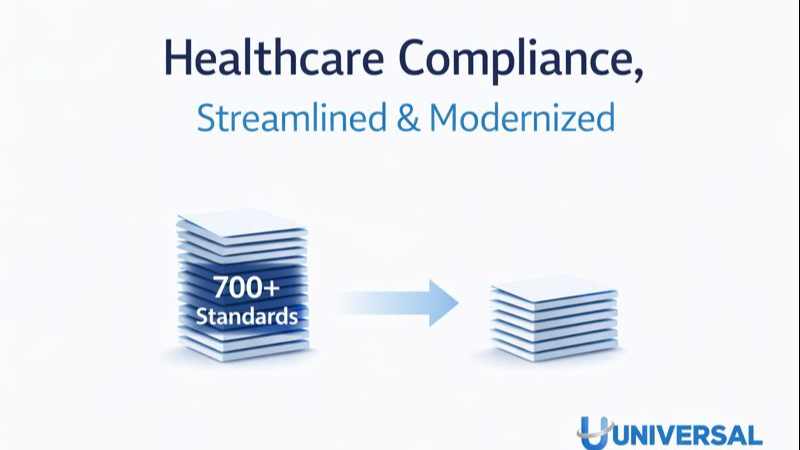
The Joint Commission’s decision to eliminate more than 700 redundant accreditation standards is one of the most meaningful compliance updates healthcare organizations have seen in years.
While the headline number is attention-grabbing, the deeper implication matters more. This shift reflects a broader recalibration of how healthcare compliance should function in a modern, high-risk, high-pressure environment. For hospital HR leaders, compliance teams, and credentialing professionals, it reinforces an important truth. Effective compliance is not about volume. It is about clarity, accountability, and real-world impact.
A Clear Move Toward Smarter Compliance
The Joint Commission’s Accreditation 360 overhaul focused on identifying standards that were duplicative, overlapping in intent, or creating ... Read More
13
Jan2026
If you've recently reviewed a criminal background screening report and noticed a candidate's date of birth was missing or redacted, you're not alone. This is becoming more common across the country, and it often raises questions for HR teams and hiring managers who want to ensure they're making informed, defensible hiring decisions.
Here's what's happening and why your background check is still complete.
The Shift in How Courts Handle Personally Identifiable Information
Courts nationwide are rethinking how they manage public access to sensitive data. While transparency in public records has always been important, there's been a growing recognition that certain personally identifiable information ... Read More

12
Jan2026
The compliance landscape for workplace drug testing is shifting faster than many employers realize. Between federal cannabis rescheduling discussions, proposed DOT panel expansions, and state-by-state cannabis law changes, HR teams and safety managers are facing a critical question: is our drug testing program actually ready for what's coming?
At Universal Background Screening, our Drug Testing & Occupational Health (DTOH) team works with employers every day who are navigating these exact challenges. Understanding what these changes actually mean for your workforce, your liability, and your day-to-day operations requires more than tracking headlines.
Here's what you need to know right now.
Federal Marijuana Rescheduling: Separating ... Read More

06
Jan2026
Background checks are part of nearly every hiring process today, but that doesn't mean they're always straightforward. Whether you're a candidate wondering what's taking so long or an employer setting up screening for the first time, we get it; you have questions.
We've compiled the most common ones here, with answers that actually help.
General Information
What does Universal Background Screening do?
We help companies make informed hiring decisions through employment background checks and workforce screening. That includes criminal history searches, drug testing, employment and education verification, motor vehicle records, occupational health services, and compliance support.
Think of us as the bridge between candidates, employers, ... Read More
15
Dec2025
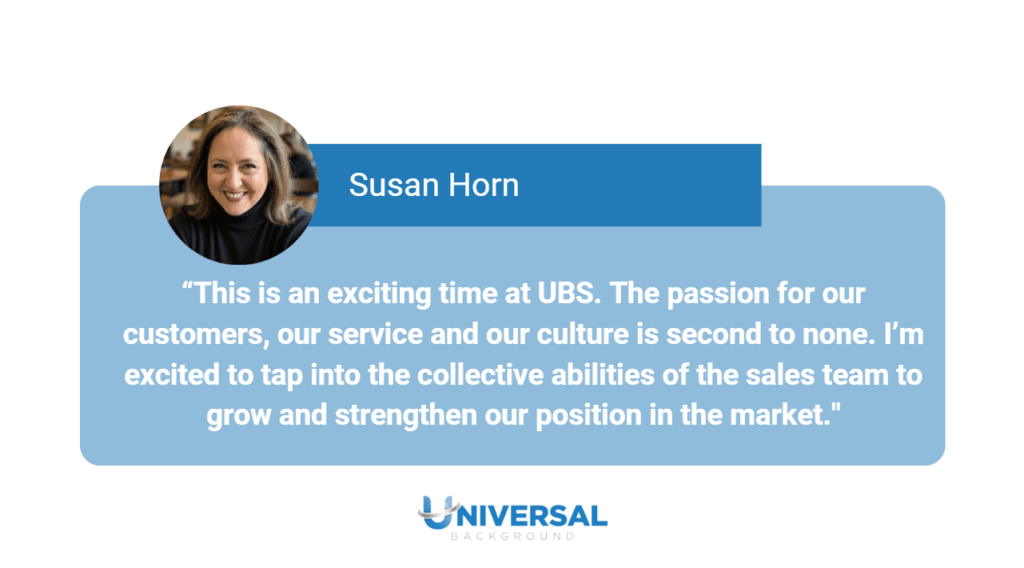
Universal Background Screening (UBS), a national leader in compliant, high-quality background screening services, has appointed Susan Horn as Senior Vice President of Sales. Horn brings extensive experience leading high-performing sales teams across the background screening and healthcare industries, with a strong focus on service excellence and long-term client success.
“This is an exciting time at UBS. The passion for our customers, our service and our culture is second to none. I’m excited to tap into the collective abilities of the sales team to grow and strengthen our position in the market,” said Susan Horn, Senior Vice President of Sales at Universal ... Read More
11
Dec2025
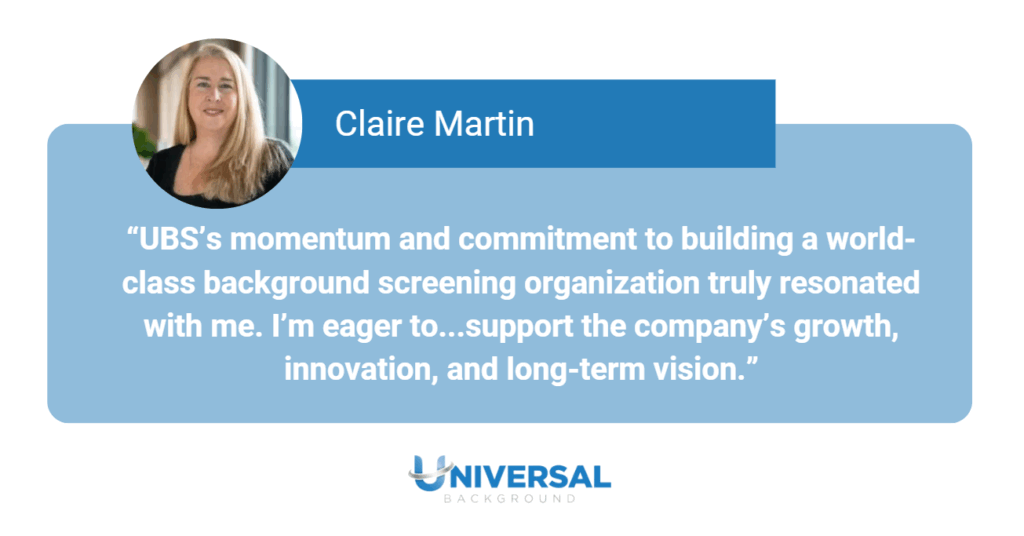
Universal Background Screening (UBS), a leader in compliant, high-quality background screening services for employers nationwide, has appointed Claire Martin as Chief Financial Officer (CFO). With more than two decades of global finance leadership across high-growth SaaS, e-commerce, and technology companies in the United States and Europe, Martin brings the financial acumen and strategic vision UBS will leverage as the company scales operations and strengthens its market position.
“UBS’s momentum and commitment to building a world-class background screening organization truly resonated with me. I’m eager to support the company’s growth, innovation, and long-term vision,” said Claire Martin, incoming CFO of Universal Background ... Read More
10
Dec2025
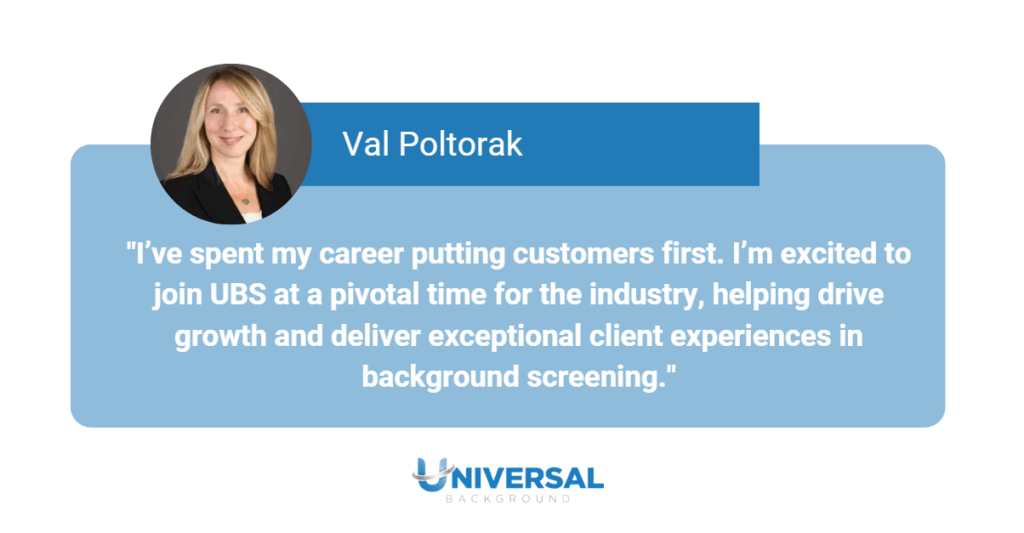
Universal Background Screening (UBS), a trusted provider of background screening and compliance solutions for regulated industries, has announced the appointment of Val Poltorak as President today. Poltorak brings more than twenty years of leadership experience across SaaS, FinTech, healthcare, staffing, and other compliance-focused sectors. Her background includes building high-performing teams, improving operations, and supporting organizations through strong, client-centered growth.
"I have spent my career putting customers first," said Poltorak. "I am excited to join UBS at a pivotal time for the industry, helping drive growth and deliver exceptional client experiences in background screening."
Before joining UBS, Poltorak held senior leadership roles at ... Read More

09
Dec2025
Smart Tags are one of the most valuable tools UBS offers to help clients manage hiring decisions with greater accuracy, speed, and consistency. As adoption grows, we've seen a need to better explain how Smart Tags work, how they're implemented, and how clients use them day to day.
This article provides a clear, updated overview based on the latest Smart Tags Product Guide, Q&A, and Sales and Implementation documentation. It's designed to help our clients understand the full lifecycle of Smart Tags, from initial setup through operational use.
What Smart Tags Do
Smart Tags automate the first level of background report review by ... Read More

08
Dec2025
Background screening isn't just about checking boxes or rushing through reports. It's about building trust through diligence, openness, and an unwavering commitment to do right by both clients and their candidates. At UBS, we take pride in setting ourselves apart, and that difference shows in our approach to verification, response, and industry leadership.
Going Direct: The Power of Primary Source Verification
Many background screening providers rely on aggregated databases, pulling in large stores of historical data without adequately checking for accuracy or currency. The result? Outdated or incorrect information, exposing clients to risk and candidates to unfair roadblocks.
UBS does more than merely ... Read More
02
Dec2025
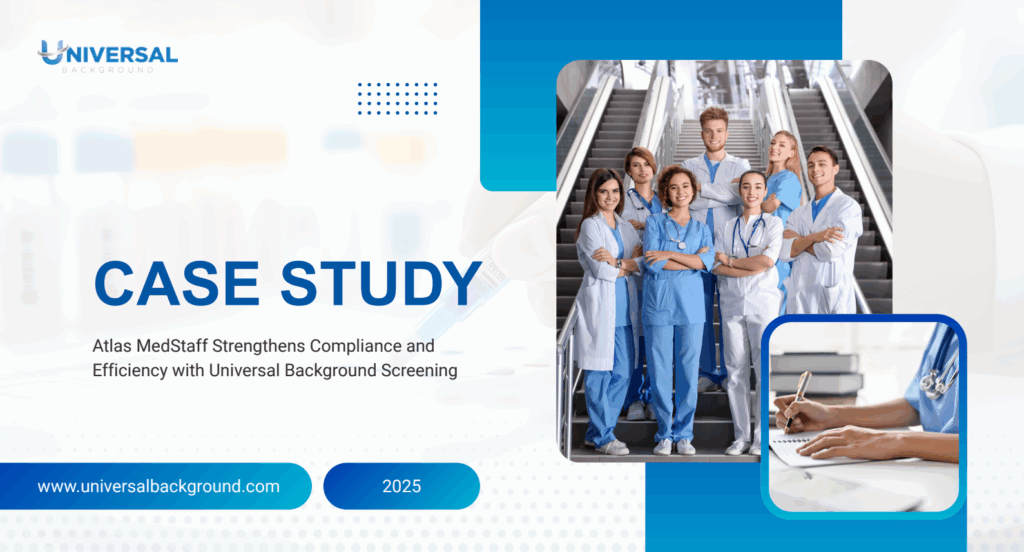
Strong compliance processes are essential in healthcare staffing, where even a small oversight can affect patient care and partner trust. For Mandy Sudbeck, Director of Compliance at Atlas MedStaff, choosing the right background screening partner is critical to keeping clinicians moving through the hiring process quickly and accurately.
Mandy began her career in property management before moving into healthcare credentialing. From day one, she learned how important reliable screening is for protecting patients and meeting hospital requirements. When she joined Atlas MedStaff, she brought her familiarity with Universal Background Screening (UBS) with her.
“I saw firsthand how Universal operates and the quality ... Read More

20
Nov2025
At Universal Background Screening, we know that hiring teams today need more than a vendor. They need a partner that continuously improves, anticipates compliance changes, and builds tools that make screening smoother for both employers and candidates. That's why our product and engineering teams deliver enhancements designed to reduce friction, strengthen compliance, and streamline workflows across the platforms your teams already use.
Below is a summary of the latest updates across Background Screening, ATS Integrations, and UHealth services. All of these features are available now or rolling out shortly for UBS clients:
Enhanced ATS Integrations for Faster Hiring
Bullhorn: eForms Ordering Now Available
For ... Read More
19
Nov2025
Hiring decisions carry significant weight. Organizations need background screening partners who maintain rigorous standards and bring genuine transparency to every engagement. At Universal Background Screening (UBS), these principles guide everything we do.
Primary Source Verification: The Accuracy Standard
Many background screening providers rely primarily on aggregated databases. While this approach offers speed, it can introduce risk. Data may be incomplete, outdated, or inaccurate. Some firms stop at summary-level information. UBS takes a different approach.
When we detect potentially adverse information in a background check, we take an additional step: we verify the information at its primary source. We confirm whether the information remains ... Read More
